I used to think typos were kind of flaky and fun. They occurred fairly infrequently and were a bit of a challenge to spot. But now that Tweetin' Trump has made typos (not to mention depressing misspellings) so utterly banal, predictable, and quotidian, they barely seem to rate a mention anymore. (Sadd!) Anyway, since most of us have more important things to worry about right now—or unless and until the day we can make typos great again—I'm back in the saddle, but will probably only be posting here from time to time. Keep up the good fight and check back in once in a while. Grreat* (for great*) shows up twice in OhioLINK, and 90 times in WorldCat. (Bear in mind that some of these might be "alt" facts and proceed with caution.)
(Image of television personality Garry Moore and Kellogg's cereal character Tony the Tiger, 3 October 1955, from Wikimedia Commons.)
Carol Reid
Sunday, February 19, 2017
Tuesday, November 8, 2016
Hilary Clinton (for Hillary Clinton)
I started writing this blog entry when I still felt sure that Hillary would win. I had something pretty hilarious planned. But sadly it looks like our prayers have not been answered. I had a friend one time who used to say that God was a Republican. Maybe he was right. In any case, it looks as if the country is a lot more "right" than most of us were willing to believe. Believe it or not, there were five hits on this typo in OhioLINK (if you put the name in quotes, 24 if you don't) and 421 (or 706) in WorldCat. Perhaps someday, with a little more prodding, God will decide to be one of us as well.
(Screen shot of Kate McKinnon as Hillary Clinton on Saturday Night Live, November 5, 2016.)
Carol Reid
(Screen shot of Kate McKinnon as Hillary Clinton on Saturday Night Live, November 5, 2016.)
Carol Reid
Thursday, November 3, 2016
Sotland* (for Scotland*)
Today is the birthday of Marie McDonald McLaughlin Lawrie, aka Lulu Kennedy-Cairns and better known simply as "Lulu." Lulu was a rock and roll pop singer (her '60s singing style has been called "blue-eyed soul") born in 1948 in Glasgow, Scotland. I ❤️ the fact that her first band was typographically and tongue-in-cheekily called "Lulu & the Luvvers." Lulu started singing as a young child and recorded a cover of the Isley Brothers' "Shout" at the age of fifteen. I'm not quite sure what it has to do with anything (although I'm quite sure it did), but Wikipedia pointedly points out: "Her father was a heavy drinker." Lulu might not have exactly looked up to the old sot, but she did find an inspiring father figure and road to success with the 1967 film To Sir with Love, starring Sidney Poitier. We found this typo three times in OhioLINK, and 489 times in WorldCat.
(Lulu happy with her new car, but sad she failed her driver's test. Photo found on the web.)
Carol Reid
(Lulu happy with her new car, but sad she failed her driver's test. Photo found on the web.)
Carol Reid
Tuesday, November 1, 2016
Aplog* (for Apolog*)
Hey, sorry! Typo of the Day for Librarians, as you've probably noticed, has been on hiatus lately. I apologize. Or as Donald Trump, by way of Alec Baldwin, might put it, "apple-ogize." In any event, I'm back now and will be posting here again—perhaps intermittently, as I work to right my recently upset applecart. Fall is a fine time for both apple-picking and apple-polishing, though, so if you've been missing all those shiny Grade-A typo suggestions the past few weeks, why not try your hand at this one? Aplog* (for apolog*) was found five times in OhioLINK, and 463 times in WorldCat.
(Don't Upset the Apple Cart, Framingham, Massachusetts, 5 October 2013, from Wikimedia Commons.)
Carol Reid
(Don't Upset the Apple Cart, Framingham, Massachusetts, 5 October 2013, from Wikimedia Commons.)
Carol Reid
Thursday, September 29, 2016
Goddd* (for Godden, Goddess*, etc.)
In a recent posting about the book Tomboy's Doll by Charlotte Steiner, I mentioned a critical review in Kirkus, which itself mentioned the 1954 classic by kidlit goddess Rumer Godden: "How much wiser is Impunity Jane?" testily asks the reviewer. True enough, to be sure, but a little misleading, perhaps, since Tommy and William (in William's Doll by Charlotte Zolotow) are people, and Jane (and Amanda) are dolls. But just like in the 1972 Zolotow book, the human friend of Impunity Jane is a boy, not a girl. Set in Victorian England, it's the story of a lonely dollhouse doll that winds up in the pocket of a young lad named Gideon, who is endowed with the ability to "hear doll wishes" and decides to take her on some exciting adventures with his pals. He is predictably teased for being a "sissy," but Jane manages to win over the little gang of haters, and eventually her pocket protector sadly but dutifully returns her to her original owner. There is nothing distasteful, wrong, or politically incorrect about dolls per se, as I hope we have demonstrated here, and they should be loved more and by more people, not less or fewer. But for Godden's sake, let's at least try and spell everybody's name right. There were two instances of today's typo in OhioLINK, and 54 in WorldCat.
(Illustration from Impunity Jane, by Rumer Godden, taken from the web.)
Carol Reid
(Illustration from Impunity Jane, by Rumer Godden, taken from the web.)
Carol Reid
Tuesday, September 27, 2016
Stien* + Stein* (for Stein* or Stien*)
The other day, I came across an old children's book I'd randomly picked up during a recent eBay buy. It's called Tomboy's Doll. I couldn't find much out about it on the web, other than a snarky review from Kirkus and one fulminating comment ("Sexism at its finest!") on Amazon. I found it rather charming, though, for my part, and really pretty "liberating" for its day. Upon reading it through a second time, I saw that the copy I held in my hands had once belonged to the "Grouse Creek School" and—yes, I thought, free associating, what a bunch of grousing, PC pedants some readers can be! First of all, I think one should always keep in mind when a book was written and by whom. Never be blinkered by an ahistorical agenda. And secondly, try and remember that books like these are the stories of individuals, not object lessons for the masses, though they often do contain a bit of a "moral." Charlotte Steiner was born in Vienna in 1900 and emigrated to the United States in 1938 while fleeing the Nazis with her family. She was a 69-year-old woman when Tomboy's Doll was published. This was three years before Charlotte Zolotow wrote the much-praised feminist favorite William's Doll, in which a young boy is eventually allowed to play with a doll (because, his parents reason, it may help him become a better father when he grows up). In Steiner's book, the protagonist is a little girl named Mary Louise, but everyone (including her mother) calls her "Tommy"—obviously her preferred name and an apparent variant on the word tomboy. (The working title had been Tommy Tomboy's Doll, which seems to underscore even more clearly the importance of self-identification.) The Amazon reviewer complains that Tommy's "mother forces her to play with a doll" and "in the end, everyone is happy because she was forced into a gender normative role." But that's really putting it too strongly, I think. Tommy's mother does give her a doll, but Tommy is "confused" because she doesn't "know how" to play with it (suggesting it's the first one she's ever had). She and her best friend Billy experiment by using it as a shuttlecock in badminton; tying it to the cherry tree to scare crows away; giving it a ride on the back of the farmer's dog Max; teaching it to "swim" in Billy's wading pond; and making it the "victim" in a game of cops and robbers. Tommy's mom (who presumably is also the person who bobbed her daughter's hair and bought her all the "boy" toys and teeshirts and blue jeans and so forth that you see her in on every page) does little more than mildly point out, "That's not how you play with a doll" and clean the thing up a bit. Eventually, Tommy manages to bond with "Amanda" after the two of them get lost in the woods (which she probably does by modeling her mother's own equanimity and empathy toward her) and starts "playing" with the doll more properly. Nowhere is it implied, however, that she's about to give up any of the other toys or games or personal style she's come to favor. Perhaps nowadays, we'd have to have the parents calling Tommy "he" or even treating her like a "gender non-conforming" doll herself, swapping out old parts for new ones that presumably fit better. Like the disgruntled Amazon reviewer, I'm being a little sarcastic there, but back in 1969 (the year of the Stonewall riots, and three years before the debut of Ms. magazine), this book surely would have been in the feminist forefront, celebrating the idea that a girl can be just like Tommy (the dedication reads, "To Nora, my tomboy friend") and just as unconditionally loved. It would also seem to be saying that "tomboys" (and perhaps even regular boys) can learn how to love and nurture other sentient beings (or their stand-ins) while still climbing trees, playing with trucks, and throwing balls. We used to call that being "well-rounded." (Tommy appears to be a pretty good artist too. Is that a drawing of Amelia Earhart hanging on her wall??) There were 29 cases of Stien* + Stein* (for Stein* or Stien*) in OhioLINK today, and 250 in WorldCat.
(Illustration from Tomboy's Doll, by Charlotte Steiner, 1969.)
Carol Reid
(Illustration from Tomboy's Doll, by Charlotte Steiner, 1969.)
Carol Reid
Thursday, September 22, 2016
Fedl* + Feld* (for Feld* or Fedl*)
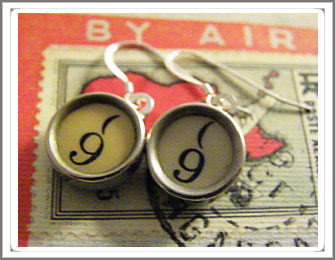
I was browsing online for something like the wonderful typewriter-key earrings I once bought at a local museum (then promptly gave away to my niece) and was pleased to find a number of websites with similar ones for sale. I was immediately drawn to one pair, each earring featuring the number 9 with the open parenthesis sign—and even more beguiled after reading the tagline accompanying them: "For those 'Get Smart' fans who dreamed of being Agent 99, here's your chance. A great set of cream keys on sterling silver 925 wires..." Challenge accepted! (And loving it!) When I was a kid, my girlfriends and I would occasionally act out the characters in the TV spy show The Man from U.N.C.L.E. and the spoofy sitcom Get Smart. I was "Agent 99," the beautiful, level-headed partner of the addlepated 86 (played by Don Adams), whom 99 liked to call "Max" in this incredibly sexy purr. I think we somehow felt that the Barbara Feldon role was the least important one (its being the only female one), but she might have "gotten smart" a whole lot faster than her more masculine colleagues in espionage. Agent 99, whose real name was never revealed on the show, holds the interesting distinction of having been the "first woman on an American hit sitcom to keep her job after marriage and motherhood." Let's keep Ms. Feldon's surname (and many others) intact as well. Would you believe... there were three cases of Fedl* + Feld* (for Feld* or Fedl*) found in OhioLINK today, and 30 more in WorldCat? Help defeat KAOS in our catalogs by acting to CONTROL this typo today!(Poster with Barbara Feldon as Agent 99, taken from the web.)
Carol Reid
Tuesday, September 20, 2016
Forword* (for Forward* or Foreword*)
After getting such good results with our typo last time, we're going to go forward today with a related one. Let's just say that the hits are quite numerous and our subject quite luminous (that is, "shedding light; bright or shining, especially in the dark"). Inez Milholland, born August 6, 1886, was the "most brilliant, beautiful, iconic feminist you never heard of," according to a recent segment on NPR about a new documentary called Forward Into Light. The title is taken from a protest sign she carried in her first suffrage parade on May 7, 1911: Forward out of error — Leave behind the night — Forward through the darkness — Forward into light! These stirring words were to become the official slogan for the National Woman's Party. New York University Law School (which she attended at a time when most other colleges were barring female students) has honored her with the "Inez Milholland Professorship of Civil Liberties." Carl Sandburg and Edna St. Vincent Millay both wrote poems in her memory. Inez Milholland (whose last public words were, "Mr. President, how long must women wait for liberty?") is often thought of as a Joan of Arc-like martyr to the feminist cause; she keeled over from sheer exhaustion and pernicious anemia while exhorting her listeners from a speaker's dais on October 22, 1916, and died a month later in the hospital. The 19th Amendment, granting women the right to vote, was finally passed in 1920 and it's sad that this passionate champion of our rights didn't last long enough to see that day. But Inez Milholland's shining spirit and political legacy will live on forever. There were 598 cases of Forword* (for forward* or foreword*) found in OhioLINK, and "too many records found for your search" in WorldCat.
(Inez Boissevain, wearing a white cape, seated on a white horse at the suffrage parade in Washington, D.C., 1913, from Wikimedia Commons.")
Carol Reid
(Inez Boissevain, wearing a white cape, seated on a white horse at the suffrage parade in Washington, D.C., 1913, from Wikimedia Commons.")
Carol Reid
Thursday, September 15, 2016
Foreward* (for Foreword* or Forward*)
With a typo like Foreward* today, I was tempted to write something about Ward Cleaver, America's favorite dad on the late great Eisenhower-era sitcom Leave It to Beaver. Ward is the strong, silent, somewhat suave, and slightly sardonic sort (suburbane, in a word, if I may coin a new one, which I guess I just did!) He's played by the late actor Hugh Beaumont, whose surname means "Beautiful Mountain" in French. "Ward has few interests at home," according to Wikipedia, "other than monitoring his sons and spending evenings after dinner sitting next to his wife on the couch in the living room reading Mayfield's daily newspaper, the 'Mayfield Press' ... Ward plays golf at a local country club, and attends church." Alas, as I now recall, I've already blogged about Mr. Cleaver here, so I decided to skip it this time and move on to something different. And this story that I found (from around the same time in history) really could not be more different. So with that little foreword dispensed with, let's begin in the lushly forested, but sadly struggling, country of Papua New Guinea. The Fore People, a traditionally peace-loving aboriginal society, also had the seemingly unsavory habit of ingesting their dead. They're certainly not the only people on earth to have ever engaged in this practice, and their reasons for it, in fact, may have even made a bit of sense. In any case, it was a commonly engaged in ritual there well into the twentieth century. The government banned "mortuary" or "funerary" cannibalism in the 1950s, after a neurological disorder known as kuru—transmitted through contact with or the consumption of infected human flesh—had reached epidemic proportions. Fortunately, though superstitions linger, over fifty years later, forward-thinking reformers have led to a happier, healthier Fore people. We got 2,179 hits on Foreward* in OhioLINK, and "too many records found for your search" in WorldCat.
("The uncivilized races of men in all countries of the world; being a comprehensive account of their manners and customs, and of their physical, social, mental, moral and religious characteristics," by Rev. J. G. Wood, with new designs by Angas, Danby, Wolf, Zwecker, 1871, from Wikimedia Commons.)
Carol Reid
("The uncivilized races of men in all countries of the world; being a comprehensive account of their manners and customs, and of their physical, social, mental, moral and religious characteristics," by Rev. J. G. Wood, with new designs by Angas, Danby, Wolf, Zwecker, 1871, from Wikimedia Commons.)
Carol Reid
Tuesday, September 13, 2016
Baskt* (for Basket*)
Today's typo blog entry may be a little bit more of a "group effort" than usual. I was curious about Hillary Clinton's colorful phrase "a basket of deplorables" to refer to the percentage of Donald Trump supporters who would probably be considered—by most standards, if not their own—to be racist, sexist, homophobic, or xenophobic. So I started to search the web for an answer and straightaway came upon this marvelous thread of conceivable origins, suppositions, usages, analogies, ad hoc humor, and other excellent examples of wordplay. One online commenter tells us: "Hillary just called ~30 million Americans 'deplorables' to keep up with Trump calling ~11 million illegals 'deportables.'" Another reader suggests that "it's a riff on 'binders full of women.'" One says: "Many have asked what the collective noun is for Trump supporters, a la 'a murder of crows.' This would seem to be a good suggestion." And yet another one remarks: "'Basket of X' as a general collective sounds like econometrics talk to me (like the 'basket' of goods used to calculate the CPI). My guess is that it's a new coinage influenced by that and 'parade of horribles.'" (According to the language columnist for the Wall Street Journal, Ben Zimmer, "parade of horribles" can be traced back to mid-19th-century New England, "when austere parades of 'ancients and honorables' held on Independence Day were spoofed, burlesque-style, as 'antiques and horribles.'") Like the number of plausible presidential candidates we're currently faced with, plus the number of weeks that there are in a year (no matter how long it's felt like), we found a couple of these in OhioLINK this morning, and a basket of 52 deplorables in WorldCat.
(CNN screen shot, taken from the web.)
Carol Reid
(CNN screen shot, taken from the web.)
Carol Reid
Thursday, September 8, 2016
Porblem* (for Problem*)
For some of us, it can be a bit of a problem. They say you shouldn't give advice unless you've been asked for it; some would advise you not to take too freely the advice of others; and most would concur that it's unwise to act as one's own counsel in a court of law. But when you tire of "trying cases in the media"—which is to say, reading yet another grim or gruesome story in the news—you can always turn to the frequently helpful and often delightfully written "advice column," a genre made famous in the 1933 novel Miss Lonelyhearts by Nathanael West. Born Nathan Weinstein, West set the stage, as it were (the film version, Lonelyhearts, starring Montgomery Clift, recently aired on TCM), for a slew of "agony aunts" to come. Though some are still published in the paper, most advice columns today can be easily found online. The mere salutations in a letter to Cheryl Strayed ("Dear Sugar...") would probably start melting your problems away before you could even put down your pen. Some of my other favorites include "Miss Manners"; "Dear Prudence"; "Savage Love"; and, though she hasn't made it onto Wikipedia quite yet, "Dear Carolyn" (along, of course, with any grammar ones I can get my hands on). Long gone, but eagerly consulted as well, were Cynthia Heimel's "Problem Lady" and "Since You Asked" by Cary Tennis. My advice to you is to take all their advice, even if somebody else had to ask for it first. And don't thank me. It's no problem. Today's typo turned up five times in OhioLINK, and 266 times in WorldCat.
(Cover of first UK edition of Miss Lonelyhearts, from Wikipedia.)
Carol Reid
(Cover of first UK edition of Miss Lonelyhearts, from Wikipedia.)
Carol Reid
Tuesday, September 6, 2016
Campagin* (for Campaign*)
No matter how you feel about Hillary Clinton, you have to admit her campaign ad "Just One Wrong Move" is absolute genius. In it, a male narrator gravely intones: "In times of crisis, America depends on steady leadership, clear thinking, and calm judgment. Because all it takes is one wrong move. Just one." This is hilariously interspersed with video clips of Donald Trump totally losing his you-know-what on camera. Regardless of whatever happens in November, Hill will always have the comforting memory of this colorful ad, in which she gets to use the words crap, shit, and fuck (rendered "crap," "shó_t," and "fuó_k" in closed captioning—with the latter two bleeped, which somehow makes it all the more alarming), while painting her panting opposition with his own blustery brush. There were ten occurrences of today's typo in OhioLINK, and 144 in WorldCat.
(Caricatures of Hillary Clinton and Donald Trump, from Wikimedia Commons.)
Carol Reid
(Caricatures of Hillary Clinton and Donald Trump, from Wikimedia Commons.)
Carol Reid
Thursday, September 1, 2016
Foreset* (for Forest*)
Albany's long-running and award-winning alternative newsweekly, Metroland, sadly bit the dust last fall and ever since we've been forced to settle for an ersatz substitute. The other day I grabbed a copy of this new and unimproved rag and decided to check out the crossword puzzle. And let me just say this: I've seen some pretty weird things, and even an outright error or two, in crossword puzzles before, but this one really takes the ____! Because, while there might not be any official standards in this regard, clearly there are some unwritten rules. (Basically, if the answer is an abbreviation, a foreign word, a slang term, or a quote, that fact needs to be somehow signaled by the wording of the clue. Other than that, though, pretty much all is fair in love and ___. And therein lies the fun!) But Rule #1 has got to be this: The clue and the answer can not contain the same word. Nor (one would have to assume, and by extension) any other "form" of the word. Yet here we have a puzzle that appears to violate that sacrosanct rule (see 9c)—really a sacred trust with the reader—not just once, or even twice, but four separate times! So let's review them, shall we? "High acidity" (HYPERACIDITY); "Creating of forests" (AFFORESTATION); "Lands filled with pine trees" (PINERA); and, last but not least, "Child's name for a cow" (MOOCOW). (I was about fixing to have one myself, at that point, as childish as it sounds.) The creator of this puzzle was well-acquainted with the dictionary, but impervious, it seems, to the charms of a thesaurus. Crossword puzzles use up a lot of paper, so how about planting a "fir tree" next Arbor Day, in a "wooded area" (a "grove" or a "thicket," let's say) with soil of "low alkalinity." And with "what a baby might call Borden's Elsie" standing by. This crossword puzzle was not all pointless and annoying redundancy (Boo, for example, was cleverly clued "You stink!"), but I had to boo it anyway. Three strikes and you're out. Or maybe that's an F—for too many forests. There were two cases of Foreset* (for forest*) in OhioLINK today, and 304 in WorldCat.
(A Cow in the Meadow, by Venny Soldan-Brofeldt, 1919, from Wikimedia Commons.)
Carol Reid
(A Cow in the Meadow, by Venny Soldan-Brofeldt, 1919, from Wikimedia Commons.)
Carol Reid
Tuesday, August 30, 2016
Poision* (for Poison*)
Drew Barrymore starred in a 1992 film called Poison Ivy. This photo isn't from that movie, but I do like her shiny green dress here, a bit like the foliage of the dreaded Toxicodendron radicans itself. According to local author Anita Sanchez, in her 2016 book In Praise of Poison Ivy: The Secret Virtues, Astonishing History, and Dangerous Lore of the World's Most Hated Plant, there was once a time when poison ivy was highly prized and its seeds "almost literally worth their weight in gold"; it would take but about an ounce of the plant's active ingredient (urushiol) to sicken thirty million people; and, while many animals eat and touch poison ivy, only humans (about 85% of us) get the itch. Birds apparently spread it, and appear to be doing so right now in downtown Albany. Which is why a friend who lives there is currently reading this book: partly out of appalled curiosity, and partly to learn how to identify the accursed thing. For most folks, poison ivy is like a distant childhood memory (remember those festive pink spots of calamine lotion?),which just goes to show how much more in touch with nature kids are than adults. Or were, anyway. Now there's probably an app for that. And if there isn't one, maybe there should be. We could call it "Poison Ivy Mon Go!" We caught ten cases of Poision* (for poison*) in OhioLINK today, plus 206 in WorldCat.
(Drew Barrymore, from Wikimedia Commons.)
Carol Reid
(Drew Barrymore, from Wikimedia Commons.)
Carol Reid
Thursday, August 25, 2016
Afternon* or Afternooo* (for Afternoon*)
Just saw a great 2013 doc called The Dog about the making of Dog Day Afternoon. Based on a true story, the original film (starring Al Pacino and John Cazale) tells the tale of a bank robbery attempt and hostage-taking in Brooklyn, New York, on August 22, 1972. The following night, I returned to the Madison Theater in order to watch Dog Day Afternoon, not for the first time, but for the first time on the big screen. The differences between the two films were striking, as were the similarities. The original was simply a great movie with amazing performances, but according to the documentary, only "about 30%" of it was true. The Dog is really more the story of John Wojtowicz himself, and one that is far more steeped in the early days of post-Stonewell activism and euphoria than one might otherwise think. It's also interesting to ponder the many ways in which both bank robbery and gay marriage—if you will pardon the awkward linkage there—have changed over the past four decades. Both films are highly recommended, with points for overall excellence, gender politics, and 1970s-style nostalgia. Afternon* (for afternoon*) got three hits in OhioLINK, and 58 in WorldCat. Oddly enough, there were almost the same number for Afternooo*: three in OhioLINK and 59 in WorldCat. Check them out in your own catalogs this afternoon during these lazy, hazy (and really sort of crazy) "dog days of summer."
(Actor John Cazale, from Wikipedia.)
Carol Reid
(Actor John Cazale, from Wikipedia.)
Carol Reid
Tuesday, August 23, 2016
Robis* + Robins* (for Robins* or Robis*)
Although it's now considered a classic of film noir, Fritz Lang's 1945 film Scarlet Street was both panned and banned upon its initial release. The critics gave it a decidedly mixed review, while the New York State Censor Board blocked its distribution by way of a statute set up to regulate "obscene, indecent, immoral, inhuman, [or] sacrilegious" films—i.e., ones that would tend to "corrupt morals or incite to crime." (The cities of Milwaukee and Atlanta quickly followed suit, which in the latter case actually led to one, and the ban was ultimately lifted.) Cast against type, Edward G. Robinson plays a good guy in this one, perhaps an overly good one. Chris Cross is a store cashier during the week and a "Sunday painter" whenever he can find time, despite his shrewish wife's utter disdain for his hobby. And it is primarily because he is so good—and so lonely—that he manages to fall in (love) with a bad woman, and her even badder boyfriend. It's a wild ride through the artsy environs of Greenwich Village, and the notorious vicissitudes of fleeting fame. More importantly, though, the film is an unsettling and moving meditation on good and evil, right and wrong, success and failure, guilt and innocence. Today's typo was found 76 times in OhioLINK and 937 times in WorldCat. You can expand your search a bit by trying Robis* + Robin* (which bumps the count up to 102 in OhioLINK, and 1073 in WorldCat), but watch out for those false positives if you do.
(Edward G. Robinson and Joan Bennett in Scarlet Street, 1945, from Wikimedia Commons.)
Carol Reid
(Edward G. Robinson and Joan Bennett in Scarlet Street, 1945, from Wikimedia Commons.)
Carol Reid
Thursday, August 18, 2016
Dinnn* (for Dinner, etc.)
I just found out (on the prom episode of The Real O'Neals) that August 9th was National Rice Pudding Day. Darn! I can't believe I missed that. I love rice pudding. Although it happens that some people definitely don't. As Winnie-the-Pooh's HUNNY-hustling progenitor, A.A. Milne, famously once put it: "What is the matter with Mary Jane? She's perfectly well, and she hasn't a pain. And it's lovely rice pudding for dinner again!— What is the matter with Mary Jane?" Rice pudding can be concocted quite easily in a crockpot with a few basic ingredients. Last night I was perusing a wonderful old letter from my German great-great-grandmother to her daughter, Karolina, who had gone to live in the United States. She's telling Lina about her niece, "Little Lina," and writes: "She is truly a wonder child, at fourteen months of age. She is already able to ask for everything clearly ... Bread, sugar, water, cake, she really knows everything." Those were trying times in Germany, it seems, but it sounds like our precious Kleinkind knew what was gut. Perhaps it was lovely rice pudding for dinner again! Today's typo was found five times in OhioLINK, and 52 times in WorldCat.
(Dessert made with rice, milk, and sugar, flavored with lemon peel and cinnamon, from Wikimedia Commons.)
Carol Reid
(Dessert made with rice, milk, and sugar, flavored with lemon peel and cinnamon, from Wikimedia Commons.)
Carol Reid
Tuesday, August 16, 2016
Genereal* (for General*)
The 1926 silent gem The General was a personal favorite of its co-director and star, Buster Keaton. Despite the fact that it received a lukewarm response from both critics and viewers—and went wildly over budget, sadly forcing Keaton to forefeit artistic control and independence in the film industry—Orson Welles once described it as "the greatest comedy ever made, the greatest Civil War film ever made, and perhaps the greatest film ever made." The General, in which Keaton's character fights valiantly, if a bit absurdly, for the Confederate Army (mostly atop and around moving trains), is based on a true story that occurred in 1862. I got a chance to see this movie in its newly restored format at the newly restored Madison Theater. Perhaps the greatest film ever made, and certainly the best one being shown in Albany, New York, last Sunday afternoon—for 35 cents no less—played to a grateful audience of five. We discovered five cases of today's typo in OhioLINK, and 331 in WorldCat.
(Buster Keaton & Marion Mack in The General, 1926, from Wikimedia Commons.)
Carol Reid
(Buster Keaton & Marion Mack in The General, 1926, from Wikimedia Commons.)
Carol Reid
Thursday, August 11, 2016
Reagen* + Reagan* (for Reagan* or Reagen*)
"Gentlemen, please, no fighting in the War Room!" (Slight paraphrase of the iconic line from the 1964 film classic Doctor Strangelove.) Two decades later, on August 11, 1984, Ronald Reagan was about to give one of his weekly addresses on National Public Radio. The subject was the right of religious high school students to meet as a club on school property after hours. He decided to open with a joke: "My fellow Americans, I'm pleased to tell you today that I've signed legislation that will outlaw Russia forever. We begin bombing in five minutes." Of course he was just kidding around with the sound checkers, and his words were not actually broadcast, but merely leaked by the press. Still, the Soviets were a tad miffed. It all blew over eventually, though, and the nuclear arms race resumed its usual pace. While searching for hits on this bilateral typo, I came across a record for a Dutch poster entitled Stop de bommen Reagen. Nuff said there, despite the misspelling of the Gipper's last name. Not to "Russia" or anything, but Reagen* + Reagan* (for Reagan* or Reagen*) turned up three times in OhioLINK, and 48 times in WorldCat. Is this thing on?
(Ronald Reagan and General Electric Theater, 1954-62, from Wikimedia Commons.)
Carol Reid
(Ronald Reagan and General Electric Theater, 1954-62, from Wikimedia Commons.)
Carol Reid
Tuesday, August 9, 2016
Janns* + Janss* (for Janss* or Janns*)
Today marks the happy day on which two amazing children's authors were born: P.L. Travers in Queensland, Australia (1899); and Tove Marika Jansson in Helsinki, Finland (1914). Both women were wellsprings of creativity. They were uncannily in touch with the interior landscape of youth, and humanity itself, and gave birth to some of the oddest, funniest, most endearing and enduring characters in all of children's literature—Mary Poppins and the Finn Family Moomintroll. I've blogged here and there about each of these artists previously, so perhaps I'll simply leave you today with this beaming, blooming photo of Tove, along with a bit of wit and wisdom from Mary P. (who was also inclined to wear flowers on her head). Once asked who she would want to be if she weren't Mary Poppins, the nanny replied, with trademark exasperation: Mary Poppins. (I could swear I read that someplace years ago, but I can't remember where. If any of you know this quote, I'd be grateful for the citation.) On the other hand, as Jansson once put it in Tales from Moominvalley (1962): "You can't ever be really free if you admire somebody too much." So three cheers for our self-assured ladies of the hour! There were eight cases of today's typo in OhioLINK, and 189 in WorldCat.
(Finnish author Tove Jansson, unknown date, probably 1960s or '70s, from Wikimedia Commons.)
Carol Reid
(Finnish author Tove Jansson, unknown date, probably 1960s or '70s, from Wikimedia Commons.)
Carol Reid
Subscribe to:
Posts (Atom)