Friday, October 19, 2012

Mountin + Mountain* (for Mountain*)

Annie Smith Peck was born on October 19, 1850, in Providence, Rhode Island, and died on July 18, 1935, in New York City. But despite starting out and ending up in relative flatlands, she spent most of her life climbing mountains. Born into a wealthy and rather forward-thinking family, Peck got off on a good foot, attending schools in Rhode Island, Michigan, Germany, and Greece. During the 1880s and early '90s, she taught archaeology and Latin at Purdue University and Smith College. As she continued traveling the globe giving lectures, she eventually found her true calling, and at the age of 35 began mountaineering in earnest, scaling Mount Shasta, the Matterhorn, and other impressive heights. She seemed to especially enjoy South America; in 1928 the northern peak of Peru's Mount Nevada Huascarán was named Cumbre Aña Peck in her honor. Today's typo is one letter shy of a mountain, with six showing up in OhioLINK and 61 in WorldCat.

(Hassan Cigarette Trading card showing Annie Smith Peck, 1911, from Wikipedia.)

Carol Reid

Wednesday, October 17, 2012

Concumer* (for Consumer*)

Are you a consumer of cucumbers? I like the phallic-looking veggies well enough myself, but I used to eat more of them when I lived with several roommates who all enjoyed tossed salad for dinner. At the time, we also shared quarters with a clowder (!) of cats and I would notice that whenever I peeled cucumbers, my sweet little feline Alfalfa would quickly come running. I finally offered him a plate full of cucumber peels to see if he would put his money where his mouth was. He did. I actually had to intervene after a few minutes since I didn't want him to end up with a distended belly full of green wax and fiber. Cucumber is a gourd, originally from India, and today comes in a wide variety of cultivars. One is even officially called "Burpless," implying that here's a cucumber that won't give you gas. I never actually had to burp my cuke-craving kitty, but I probably could have if I had wanted to. One of his most amazing qualities was his ability to hang upside down, or draped over my shoulder, completely relaxed, like a rag doll. Here's to the awesome Alfalfa as well as the totally cool cucumber. There were two of these in OhioLINK this morning, and 23 in WorldCat. A "low probability" typo on the Ballard list, this one is a relatively easy pickle to get out of.

("Dogs like cucumbers & cucumbers like dogs," 2 August 2004, from Wikimedia Commons.)

Carol Reid

Monday, October 15, 2012

Interupt* (for Interrupt*)

We interrupt our program for this special report (numerous things have conspired to slow down production lately), but we'll be right back after a short non-commercial break. Typo of the Day shall be posting intermittently for a while until we eventually settle into a (most likely) 3x-a-week publication schedule. In the meantime, here's a little brain teaser for you. How many words end in rupt? I could only think of three off the top of my head: disrupt, erupt, and interrupt. Can you come up with any more? (Hint: there are ten of them.) There were also nine occurences of Interupt* in OhioLINK today, and 278 in WorldCat. Okay, gotta go swim in some other circles now. See you soon!

(Chaetodon interruptus, by Xavier Romero-Frias, 1991, from Wikimedia Commons.)

Carol Reid

Friday, October 12, 2012

Contining (for Continuing)

People who pursue what's known as "continuing education" are often independent thinkers, audodidacts of a sort, driven to seek out learning in a way that's different from the mass exodus out of high school and into college that most younger students experience. So if, in an attempt to drum up class solidarity, your teachers try and tell you that "there's no U in continuing," you'll just have to speak up and correct them: Indeed there is. (Although twelve records in OhioLINK and 200 in WorldCat would seem to want to argue otherwise.) But listen, when you're right, you're right, even if you're the only one. Please continue to keep up the good work by correcting today's typo in your own library's catalog.

(Pinus tabuliformis, foliage and cone, Beijing, China, by Shang Ning, 18 January 2009, from Wikimedia Commons.)

Carol Reid

Wednesday, October 10, 2012

Princple* (Principle*)

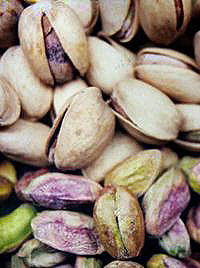
The other night during a Scrabble game, while looking up a word in the dictionary, I serendipitously discovered that the word pistache means a sort of green. Pistachios are sometimes dyed red or green in order to increase their eye appeal, but the so-called nuts themselves (they're actually seeds or "drupes") can appear slightly green or even reddish in nature as well. The largest American source of pistachios is California, but the biggest producer in the world is Iran. Pistachios are grown and enjoyed all over, however, and actually look to be pretty pleased with themselves, if the tendency known as pareidolia has anything to do with it. (Another nut-like example of this is the little bearded man you can see if you carefully split apart the two halves of a peanut.) According to Food Editorials: "Pistachios are joyful. In China people refer to them as 'happy nuts' while in Iran they are known as 'smiling nuts.' Middle Easterners call the pistachio the 'smiling pistachio.' In these countries, if you hear the pistachios shells opening on a tree while you are resting beneath it, it is considered good luck..." Pistachios are also unique in that they can be roasted and salted while still in the shell. Though it's possible to buy them already shucked (probably the best way to observe their natural green color), I've often thought it just as well that they generally come in those little beige shells (which can then be saved and used for any number of things, including craft projects and slug deterrents in the garden), if for no other reason than that it inhibits overeating. (Especially if you're as nuts about nuts as I am). In fact, in 2008 Dr. James Painter of Eastern Illiniois University came up with something called the Pistachio Principle, which basically says that "the act of shelling and eating pistachios one by one slows one's consumption, allowing one to feel full faster after having eaten less." Getting back to whether or not the word pistache means the color of a pistachio (or is even an English word at all), I actually couldn't find much confirmation of that beyond the dictionary I consulted the other night at a friend's house. But marginal though it may be, I like the word anyway; it's like pastiche with the first two vowels reversed. Which puts me in mind of the movie Great Expectations with Ethan Hawke. That film had so many shades of green in it (a veritable pastiche of pistache) that upon seeing it in the theater in 1998, my friend and I thereafter dubbed it "Green Expectations." There were 25 cases of Princple* found in OhioLINK today, and 157 in WorldCat.

(Pistachio Tree at Château Noir, by Paul Cezanne, at the Art Institute of Chicago, courtesy of Wikimedia Commons.)

Carol Reid

Monday, October 8, 2012

Agengy, Agengies (for Agency, Agencies)

The mighty Genghis Khan was the grandfather of Kublai Khan, the eponymous subject of the Samuel Taylor Coleridge dream-poem that begins, "In Xanadu did Kubla Khan a stately pleasure dome decree..." and then just gets better from there. In the twelfth century A.D., Genghis Khan showed great agency in the founding of the Mongol Empire, which became the "largest contiguous empire in history after his demise." Perhaps the most resonant words in the vibratingly vivid Kubla Khan are those recurring "sunny pleasure domes with caves of ice," which& appear to be reflected in the beautiful Kazakhstani coin pictured above. Whether you work for a stately government agency or a more privately owned dome of pleasure, you can always extend its empire a little bit further by keeping your typos in check. Agengy was found 16 times in OhioLINK, and Agengies twice, whereas WorldCat turned them up 89 and 20 times apiece.

(Reverse commemorative 100 Tenge coin depicting "Chingiz Khan," 2008, from Wikimedia Commons.)

Carol Reid

Friday, October 5, 2012

Manly + Manley (for Manley or Manly)

A yard is a terrible thing to waste, and every summer I watch as the epic battle of Grass versus Crabgrass, Clover versus Purslane, and all the other warring weeds in between takes place out on the patchy plot of sandy dirt behind my house. I sigh as the flowers I've tried to grow shrivel up in the sun and fade in the shade. And I vow to do better at this next year. But then all is forgiven and forgotten for a time as the entire yard becomes blanketed in yellow, brown, and orange leaves from the rapidly denuded trees that are hovering nearby. One of the first poems I remember studying in high school (and the very first one I chose to memorize during a recent attempt to commit a variety of them to heart) was called "Spring & Fall: To a Young Child" by Gerard Manley Hopkins: "Margaret, are you grieving / Over Goldengrove unleaving? / Leaves, like the things of man, you / With your fresh thoughts care for, can you? / Ah! as the heart grows older / It will come to such sights colder / By and by, nor spare a sigh / Though worlds of wanwood leafmeal lie; / And yet you wíll weep and know why..." I love that word, leafmeal. (What do health-conscious caterpillars eat for breakfast? Answer: Leafmeal!) I noticed bags full of leaves (soon to be turned into a sort of "leafmeal" by the city, and eventually into compost for the community gardeners next year) lined up along the streets this morning, waiting to be picked up with the weekly trash and recycling. Somehow it all seems rather sad, and makes me want to skip right over winter and pick up again in the spring. "... Now no matter, child, the name: / Sorrow's springs are the same. / Nor mouth had, no nor mind, expressed / What heart heard of, ghost guessed: / It is the blight man was born for, / It is Margaret you mourn for." There were 29 cases of today's combination typo in OhioLINK, and 210 in WorldCat. Some of them were false positives; some had or probably should have had an explanatory "sic" or "i.e." on them; some involved antiquated titles that may have included personal names written differently on the work itself than on the authorized headings in NACO. And then there was one record where I wasn't quite sure whether we were dealing with typos or wordplay: A Queer Chivalry: The Homoerotic Asceticism of Gerard Manley Hopkins, including chapter headings such as "Queer Courtship: Veiled Eros in a Manly Craft" and "Manly Beauty: A Solace and a Scourge."

(Young British poet, Gerard Manley Hopkins, from Wikimedia Commons.)

Carol Reid