Friday, March 18, 2011

Interati* (for Internati* and Interacti*)

This week's posts had a more international flavor than I originally planned. They might not have been the most rational collection of ideas, but I hope you found them interesting. I have noticed that when we verify a typo, we often learn that a typo in English is a real word or name in a foreign language, which is why we should be very cautious with global changes.

Today's typo, Interat* is in Section B, high probability in the Ballard list. This is probably because there are many options for the intended word. I found hits that seemed like they were supposed to be Interact* (the typo misses a letter), Iterati* (the typo adds a letter) and Internati* (missing a different letter). You may find others, so I would strongly suggest you interact with your catalog in multiple iterations to find all domestic and international books with this huge typo.

Liz Bodian
Chicago Public Library

Image of the world as pictured in 1689 fr0m Wikimedia Commons.

Thursday, March 17, 2011

Nuculear* (for Nuclear*)

This has been a very sad week for Japan. The tragedy of the great physical devastation by the earthquake and tsunami has been exacerbated by the damage caused to one of the nuclear plants there. Nuclear is, of course, also a frequently mispronounced word, and today's typo, nuculear, is basically a transcription of the most popular mispronunciation (it could also be spelled nucular).

Nuculear* is a very low-probability typo. It only occurs once in OhioLINK (although that is in a subject heading) and 8 times in WorldCat, but given the fact that nuclear energy is on everyone's mind, this is a great time to clean up this small disaster in our catalogs.

Liz Bodian
Chicago Public Library

Image of the Fukushima I Nuclear Power Plant from Wikipedia, under Creative Commons license

Wednesday, March 16, 2011

Hugary (for Hungary or Sugary)

I just got a new dining table (from the Amish, who relate to yesterday's post) and now I need new tablecloths. I have a friend from Hungary who is a seamstress, and she did a beautiful job making some out of material I bought. We always make fun of her because she spends the winter in Chicago and the summer in Hungary. Until I met her, I didn't know anybody wintered in Chicago!

Today's typo is one that could be for two different, unrelated words, and is, in fact, a valid proper name (though I only found one person with that name). I did find a selection of delicious-looking sugary Hungarian desserts online that I might try some time!

Image of apple strudel, a traditional Hungarian dessert, from Wikimedia Commons

Tuesday, March 15, 2011

Menonite or Mennonnite (for Mennonite)

I just read a great book called Mennonite in a Little Black Dress. It's about a woman who grew up Mennonite, left and got married, then went back to stay with her parents when her husband left her for a man he met on Gay.com. It was incredibly funny, and I highly recommend it.

There is a lot of confusion about Mennonites, including how to spell their name. They are named after Menno Simons and are an anabaptist movement which started in central Europe in the 16th century. Although they are often confused with the Amish and seen as very traditional, the Amish actually broke off from the Mennonites because they thought the latter were too liberal.

Menonite is a low-probability typo, and Mennonnite is even more rare. The first appears only twice in OhioLINK, and 28 times in WorldCat. You can remember that there should be two n's at the beginning because that is how Menno spelled his name.

Liz Bodian
Chicago Public Library

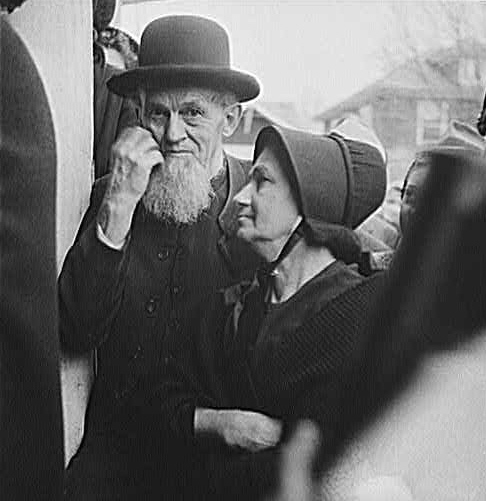
Image of a traditional Mennonite couple from Wikimedia Commons.

Monday, March 14, 2011

Tme for Time

I hope all of you remembered to spring ahead yesterday, and were on time for work this morning. For some reason, whenever I think of clocks (which is rarely misspelled), I think of the program CLOCKSS (Controlled LOCKSS), which is attempting to build an archive of articles abandoned by their publishers. This is a related program to LOCKSS (Lots of copies keep stuff safe), which maintains currently available materials. As more and more journals become digital-only, it will become even more important to make sure we do not lose access to these valuable pieces of scholarly literature. If you haven't explored these programs, now is the time to do so!

Tme is a low-probability typo, found 11 times in OhioLINK and 33 times in OCLC. Actually, it could be higher than that, but in order to avoid false hits with acronyms, I did a search for "tme and time." You may want to try other searches as well.

Liz Bodian
Chicago Public Library

Image of an alarm clock from Wikimedia Commons.

Friday, March 11, 2011

Ezra + Erza (for Ezra)

Today is likely to be a Snowy Day wherever you happen to be. It also happens to be the birthday of Ezra Jack Keats, born Jacob Ezra Katz on March 11, 1916, in Brooklyn, New York. Keats won the Caldecott Medal in 1963 for a classic work of children's literature called The Snowy Day. The book features a young African-American boy named Peter, who reappears in six other books later on. Black characters were rare in children's books at that time; Keats says he got the idea to write about one from a 1940s issue of Life magazine. Keats grew up poor and, unable to afford art supplies, worked with scraps of wood, paper, and cloth instead. This ultimately led to his distinctive collage style of illustration. He illustrated a total of 33 books, 22 of which he also wrote. Always sensitive to prejudice and discrimination, he changed his name after World War II to "Ezra Jack Keats"—turning Jacob into "Jack" and Katz into "Keats." But he kept the Ezra. We found five cases of Ezra + Erza in OhioLINK today.

(Book cover for The Snowy Day, from Wikimedia Commons.)

Carol Reid

Thursday, March 10, 2011

Barabara + Barbara (for Barbara)

Theda Bara, born Theodosia Burr Goodman, was the original movie "vamp" (short for vampire and slang for sexually predatory female). Bara, along with Valeska Suratt and Musidora, popularized this femme fatale persona during the early days of the silent screen. Her stage name has become a household word, but its origins are a matter of some debate. The Guinness Book of Movie Facts and Feats claims it came from director Frank Powell, who had discovered she had a relative named Barranger. However, those of a more exotic turn of mind at the time imagined it to be an anagram for "Arab Death." The Goodman family legally changed its surname to Bara in 1917. Check your catalogs carefully and legally change all instances of Barabara to Barbara—although you should probably check the works in question, per usual, if the occurrence is in a transcribed field. We found 54 of these twin-vamped typos in OhioLINK today, and over a thousand in WorldCat.

(Theda Bara in Carmen, a lost film made in 1915, from Wikimedia Commons.)

Carol Reid