Friday, September 9, 2011

Bureac* (for Bureauc*)

Richard Titmuss (1907–1973) was a British academic and researcher. He established the field known as "Social Administration" (or "Social Policy" as it later came to be called) and held the founding chair in that subject at the London School of Economics. According to his obituary, Titmuss was "fascinated by the problem of making large social service bureaucracies humane and sensitive to individual human need." His most influential work may have been his last, a book entitled The Gift Relationship: From Human Blood to Social Policy. Along with trying to navigate their way through and around the brambles and thickets of actual bureaucracies and bureaucrats, many people also encounter difficulties when attempting to spell these words: one of the commonest blunders is omitting the second U. We Americans do not seem to love our U's as dearly as the English do, at least with respect to words like color (colour), honor (honour), favor (favour), and neighbor (neighbour). And perhaps this is why, once we've maneuvered past those first few vowels (the U, the E, and the A), we wearily find ourselves wanting to skip over that second-in-command U. Don't do it, though—it'll only produce a lot of red tape. Or, at any rate, a lot of red squiggly lines in your word document. There were 22 cases of Bureac* in OhioLINK this morning, and 277 in WorldCat.

(Richard Titmuss, from Flickr and Wikimedia Commons.)

Carol Reid

Thursday, September 8, 2011

Crativ* (for Creativ*)

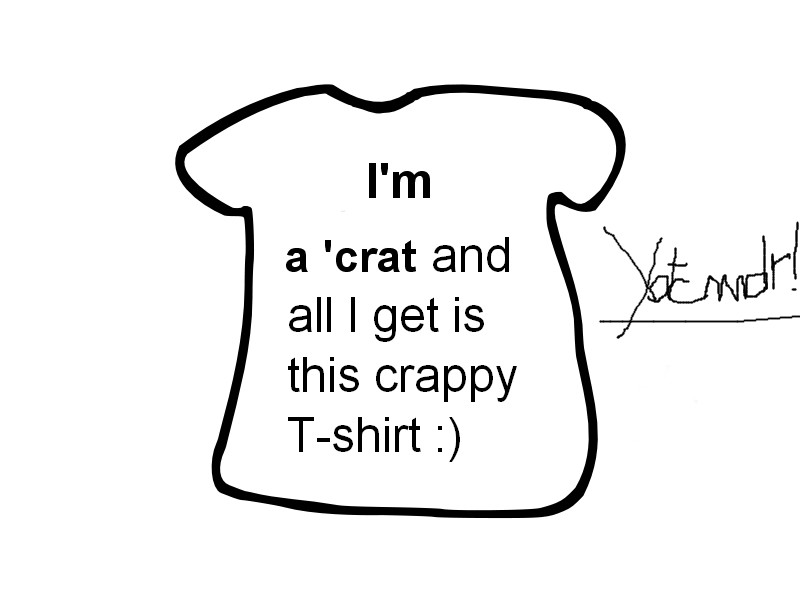
A bureaucrat is defined as "an official of a bureaucracy" or, perhaps a little more judgmentally, as "an official who is rigidly devoted to the details of administrative procedure." Somebody who isn't just attentive, but rather rigidly devoted, to a boring office job doesn't really seem like one who'd appreciate a jaunty nickname; however, it does appear that some bureaucrats are actually called 'crats, to judge by this "crappy" T-shirt. (Crat sounds to me like a cross between "crap" and "drat," but either way you cut it, it does sound like kind of a drag.) Some people tend to get rather creative when spelling words like bureaucratic (too many vowels, I guess), whereas others prove a bit hasty when it comes to things like creativity. There were 30 cases of Crativ* in OhioLINK last time I checked, and 948 in WorldCat. Look all your spelling over carefully today—and don't be a "crat" and make your secretary do it!

(Caution sign by Michael Wilson, York, U.K., 2009, from Wikimedia Commons.)

Carol Reid

Wednesday, September 7, 2011

Recrod* (for Record*)

Beryl Burton, the U.K.'s greatest female bicyclist, was born on May 12, 1937, in Leeds, West Yorkshire. As a child, Beryl was beset with chronic health problems, including rheumatic fever, and spent over a year in a convalescent home. She got married in 1955 and her husband, Charlie, introduced her to cycling. Typically Taurean, she stubbornly persisted at it; two years later she took home her first medal, put the pedal to the metal, and never looked back. At the age of thirty, she set a new record for the women's 12-hour time trial, which surpassed the men's record at that time, and she sustained this distinction for the next two years. According to Wikipedia: "While setting the record she caught and passed Mike McNamara who was on his way to setting the men's record at 276.52 miles and winning that year's men's British Best All-Rounder. She is reputed to have given him a liquorice allsort as she passed him. Apparently, McNamara ate the sweet." As if to sweetly press the point even further for the distaff side, in 1982 Beryl and her daughter Denise set a British 10-mile record for women riding a tandem bicycle in 21 minutes and 25 seconds. A couple of other distinctly feminine notes also grace Burton's legacy: a memorial garden in her hometown of Morley; and the "Beryl Burton Cycle Way," which allows cyclists to travel the 2.8 kilometers between Harrogate and Knaresborough without using the A59, considered to be England's most dangerous roadway. There were 11 records in OhioLINK containing the typo Recrod* and 140 in WorldCat.

(Beryl Burton, from the LENOR blog.)

Carol Reid

Tuesday, September 6, 2011

Apolg* (for Apolog*)

Mea culpa, mea culpa, mea maxima ... oh, forget it! Katt Williams issued the classic "non-apology" over the weekend when he was called to account for an extended anti-Mexican rant he permitted himself, in the style of Michael Richards several years ago, after being heckled in a comedy club. "If I said anything anti-Mexican," he told CNN, "I apologize for its anti-Mexican-ness." And even worse: "I apologize for the fact that the word 'anti-Mexican' is being said to a black guy in America." (It kind of gives new meaning to the phrase "a sorry excuse" ... Sorry, but that's a sorry excuse for an excuse!) However, insincere apologies have become de rigueur in show business and pretty much anyplace else where there are people to take offense. In any event, I too have been warned that I might've gone a bit too far in Monday's blog post about not wearing white after Labor Day. So if I said anything inappropriately anti-anything yesterday, I apologize for its possibly inappropriate anti-anything-ism. And I'm also sorry to say, but there were 11 hits on Apolg* in OhioLINK today and 129 in WorldCat.

(Katt Williams, 10-23-2008, courtesy of New York Daily News and Wikimedia Commons.)


Carol Reid

Monday, September 5, 2011

Whiteman + Whitman (for Whitman or Whiteman)

Today is a day off from working for the man—and you may be sitting around in your jammies having a nice, if cash-poor, "staycation" or, like me, laboring to clean out the basement or something. Although if you're actually planning to get dressed and go somewhere, you might also be thinking of the hoary etiquette rule: don't wear white after Labor Day. But where is the sense in that? Most of us assume it has something to do with snobbery (if not actual racism: "That's mighty white of you!") and the fact that summer clothing is generally "lighter" than the heavy black and blue of conventional workaday wear. In truth, however, winter is a far whiter season than summer, with its pale gray skies, denuded trees, and slumbering flowers under blankets of snow. Walt Whitman wrote in Leaves of Grass, in answer to the question what is the grass: "...I guess it is a uniform hieroglyphic ... sprouting alike in broad zones and narrow zones, growing among black folks as among white..." So cast off your shackles and wear whatever colors you like, whenever you want, because ultimately death comes to us all. As Walt also wrote in "Reconcilation": "...I draw near, bend down and touch lightly with my lips the white face in the coffin..." We uncovered 13 cases of Whiteman + Whitman in OhioLINK and 83 in WorldCat. You may not care a whit about typos today, but this could be a good one to get you back into the drab routine of working tomorrow, regardless of what you'll be wearing.

(Girl in a White Dress by William Orpen, 1878-1931, from Wikimedia Commons.)

Carol Reid

Friday, September 2, 2011

Archtyp* (for Archetyp*)

One morning in 1916, newspaperman Don Marquis (pronounced MAR-kwiss) came into his office at the New York Sun, where he had left a fresh sheet of paper in his typewriter, to find a large cockroach on it hopping from key to key. This was the genesis for the work he would become best known for, The Lives and Times of Archy and Mehitabel. It's a book of "vers libre" composed by an insect with the "soul of a poet." It describes his philosophy of life and assorted adventures with a cat named Mehitabel, who grandly lays claim to a previous incarnation as Cleopatra. "Toujours gai," she would say, "Toujours gai." Archy painstakingly produces copious copy for his "boss" every night, though always in small letters and minus punctuation since it was too hard for him to hold down the Shift key. This was not his actual preference, however; as E. B. White puts it in the introduction: "He was no e e cummings." In fact, in the poem entitled "CAPITALS AT LAST," he rejoices in a happy accident in which the Shift key had become temporarily locked. We sometimes see TyPoS like that ToO, but like Archy, can't do very much about it since our search mechanism doesn't discriminate between upper and lower case. We found 15 cases of Archtyp* in OhioLINK today, and 354 in WorldCat.

(Cover of my copy of The Lives and Times of Archy and Mehitabel, by Don Marquis, with illustrations by the great George Herriman.)

Carol Reid


Thursday, September 1, 2011

Kindergarden* (for Kindergarten*)

Mell Lazarus is the creator of the comic strip Miss Peach, a chronicle of the fictional fount of learning known as the Kelly School, named after "Pogo" cartoonist Walt Kelly. It debuted in the New York Herald Tribune in 1957 and continued to run for 45 years; it was syndicated in 300 newspapers worldwide. It featured the eponymously peachy Miss Peach and her fellow teacher, the unretiring octogenarian, Miss Crystal; the school principal, Mr. Grimmis; and the gym teacher, Mr. Musselman. But the real show-offs of the show were the kindergarten kids themselves: the irrepressible Freddy, Marcia, Ira, Arthur, Francine, and Lester, plus a few other tots who would pop in from time to time. Publisher Al Capp wrote the introduction to Miss Peach, where his doting admiration of Lazarus is made clear: "... although I was, for that moment, the boss, I hadn't discovered the priceless secret of our art that he had—that if you were a humorist with more understanding than most other humorists, you could fill emptiness with delight and silence with wit. This is Mel's genius..." We discovered 20 cases of today's typo in OhioLINK and 413 in WorldCat. Watch out for this one, though: while kindergarden is generally considered to be a misspelling of kindergarten, it might well appear that way on the piece itself, being the German word for "children's garden."

(Cover of my own copy of Miss Peach, 1958. Click pic for a closer peek.)

Carol Reid